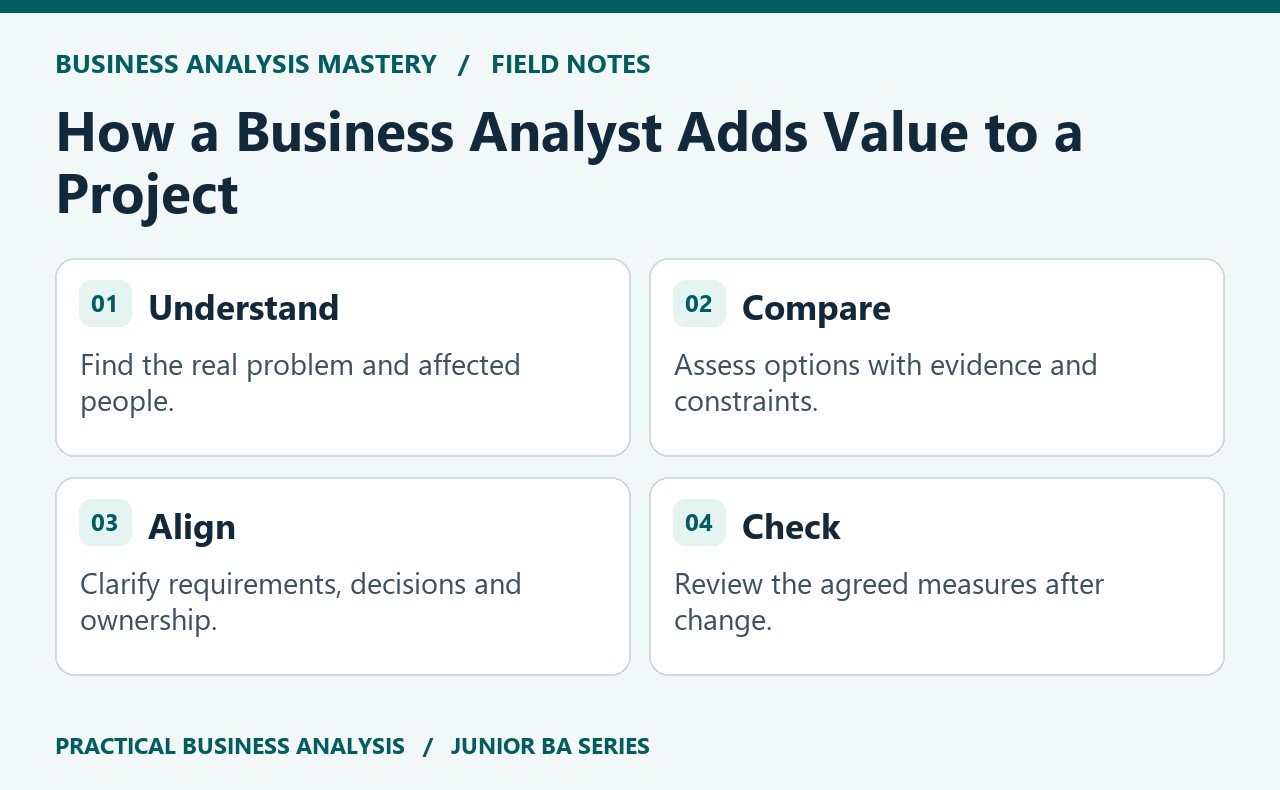
How a Business Analyst Adds Value to a Project
A BA’s value shows in the decisions and delivery they help make clearer. Follow one project example from an unclear problem to a checked outcome.
Value comes from improving decisions
A Business Analyst helps a team understand a problem, agree what matters and choose a workable response. That contribution is practical: fewer untested assumptions, clearer requirements, visible impacts and better ways to check whether a change has achieved its purpose.
The BA does not own every decision or guarantee a project result. Sponsors set direction, specialists advise on their areas, and delivery teams build or implement change. The BA connects these perspectives so the group can make informed choices and keep the intended outcome in view.
Worked example: reducing missed service requests
Imagine a service team says requests are often missed and asks for a new tracking tool. Before moving straight to procurement, the BA speaks with staff and users, examines available records, and maps how requests currently arrive, get assigned and reach completion. This may reveal that requests come through several channels and ownership is unclear.
The BA helps stakeholders agree the actual need: every request should have an owner, status and next action. The team compares options such as clarifying the current process, using an existing system differently or introducing a new tool. Each option is considered against effort, cost, risk and expected benefit, with Finance and technical colleagues checking their relevant assumptions.
Once an option is chosen, the BA documents the agreed workflow, roles, exceptions and information needs. They support delivery conversations, help resolve questions and involve users in reviewing examples. After implementation, the team checks measures it agreed in advance, such as unassigned requests or time to first response. The BA can help interpret results; the service owner remains accountable for ongoing performance.
Make the contribution visible
Useful BA outputs are not paperwork for its own sake. A process map can expose a hand-off problem. A requirements view can help developers and testers share the same understanding. A decision log can prevent a settled choice from being reopened without new evidence. Choose the lightest artefact that helps the people involved do their work.
Keep links between the problem, requirement, decision and measure. When priorities change, make the effect clear so stakeholders can decide what to adjust. Ask colleagues to confirm that the analysis reflects their needs and that unresolved issues have an owner.
Focus on outcomes, not activity counts
Meetings held and documents produced do not by themselves show value. Look for observable improvements in shared understanding, decision quality, delivery clarity or service outcomes. Agree measures with the people accountable for the change, and be honest about factors outside the BA’s control.
To strengthen these skills, practise eliciting requirements, mapping processes and assessing options. BA Mastery’s business analysis courses offer structured exercises for applying these methods to project work.