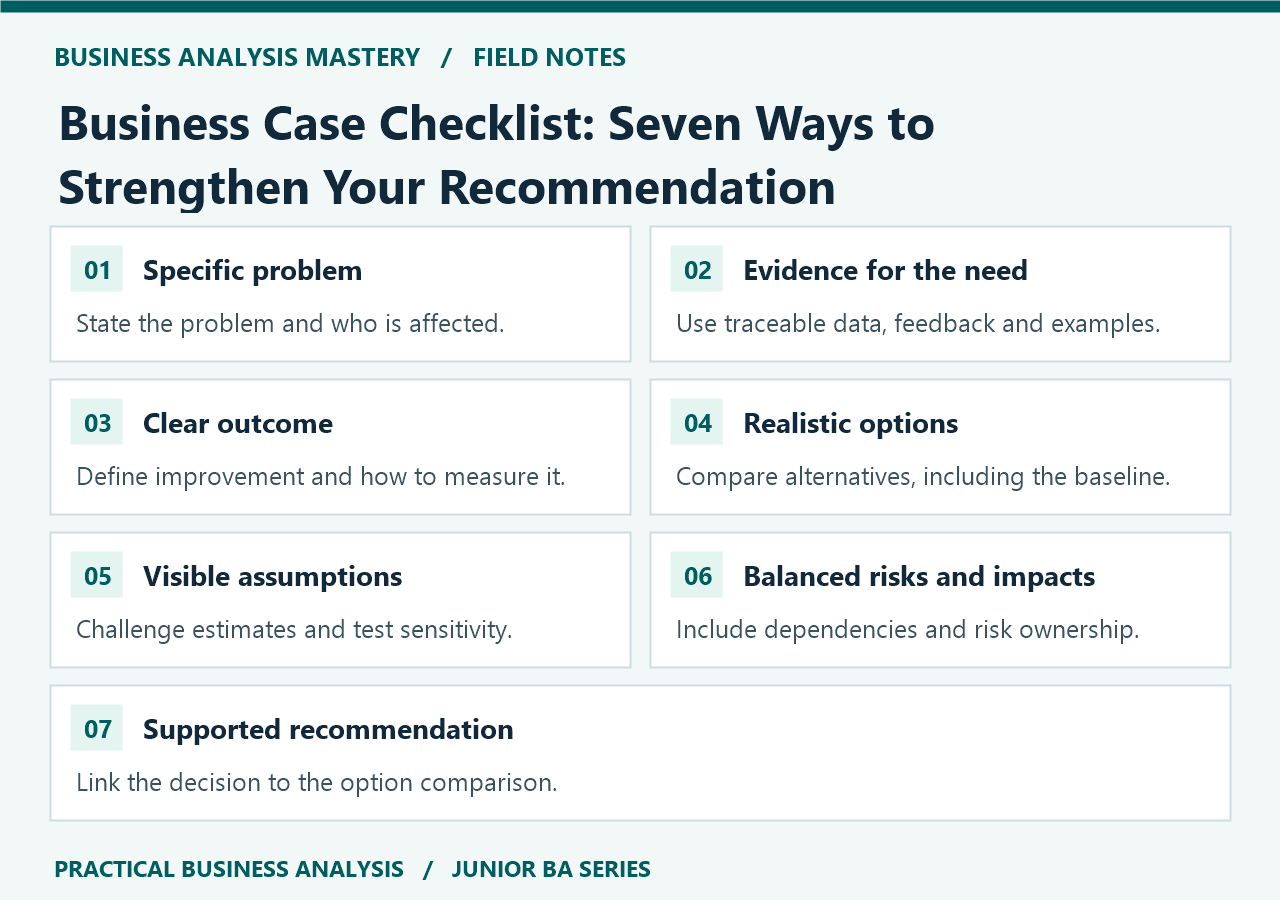
Business Case Checklist: Seven Ways to Strengthen Your Recommendation
Before a sponsor review, use these seven questions to check whether your business case is clear, evidence-led and ready to support a decision.
Seven checks before sponsor review
A useful business case makes it easy to understand the need, weigh the choices and decide what to do. It does not need grand language. It needs a clear argument, reliable evidence and honest treatment of uncertainty. Work through these checks with the people who own the service, delivery and finances.
-
Is the problem specific? Describe who is affected and what is happening now. Avoid broad claims such as “the process is inefficient” unless you explain what that means.
-
Is the need supported by evidence? Use data, user feedback, policy or operational examples. State the source and date, and distinguish measured facts from estimates.
-
Is the outcome clear? Explain what should improve and how you would recognise success. Measures should relate to the original problem.
-
Have you considered more than one option? Include a realistic baseline or do-nothing option, and explain why the alternatives are feasible or unsuitable.
Check the reasoning, not only the writing
-
Are assumptions visible? Identify estimates about demand, costs, time savings or adoption. Ask the relevant specialists to challenge them, and show how the conclusion changes if an important assumption is wrong.
-
Are risks and impacts balanced? Include delivery dependencies, operational disruption, accessibility, data and security considerations where relevant. Note who will manage each material risk.
-
Does the recommendation follow from the comparison? Explain why the preferred option best meets the agreed need. Confirm costs and benefits with Finance and delivery colleagues, and state what approval or resources are required.
Apply the checklist to a small example
Imagine a team is considering a shared request-tracking system because requests are missed across several inboxes. The case should show how often requests are lost, who is affected and what a better outcome looks like. Compare improving the current process with buying or configuring a system. Include staff time, setup and ongoing support, not just the licence price.
If the evidence is limited, say so. You might recommend a short pilot with agreed measures before a wider commitment. That makes uncertainty part of the decision instead of hiding it.
Make the next review easier
Ask a reviewer to trace the argument from need to recommendation. Can they find the evidence, understand the options and see the key assumptions without searching through appendices? Tighten any sections that repeat information or use unexplained terms.
Use this checklist alongside your organisation’s business case template and appraisal rules. For a full section-by-section structure, see the BA Mastery guide to writing a business case; the companion article on common mistakes can help with a final quality check.