How to Structure a Business Case: A Practical Guide for Business Analysts
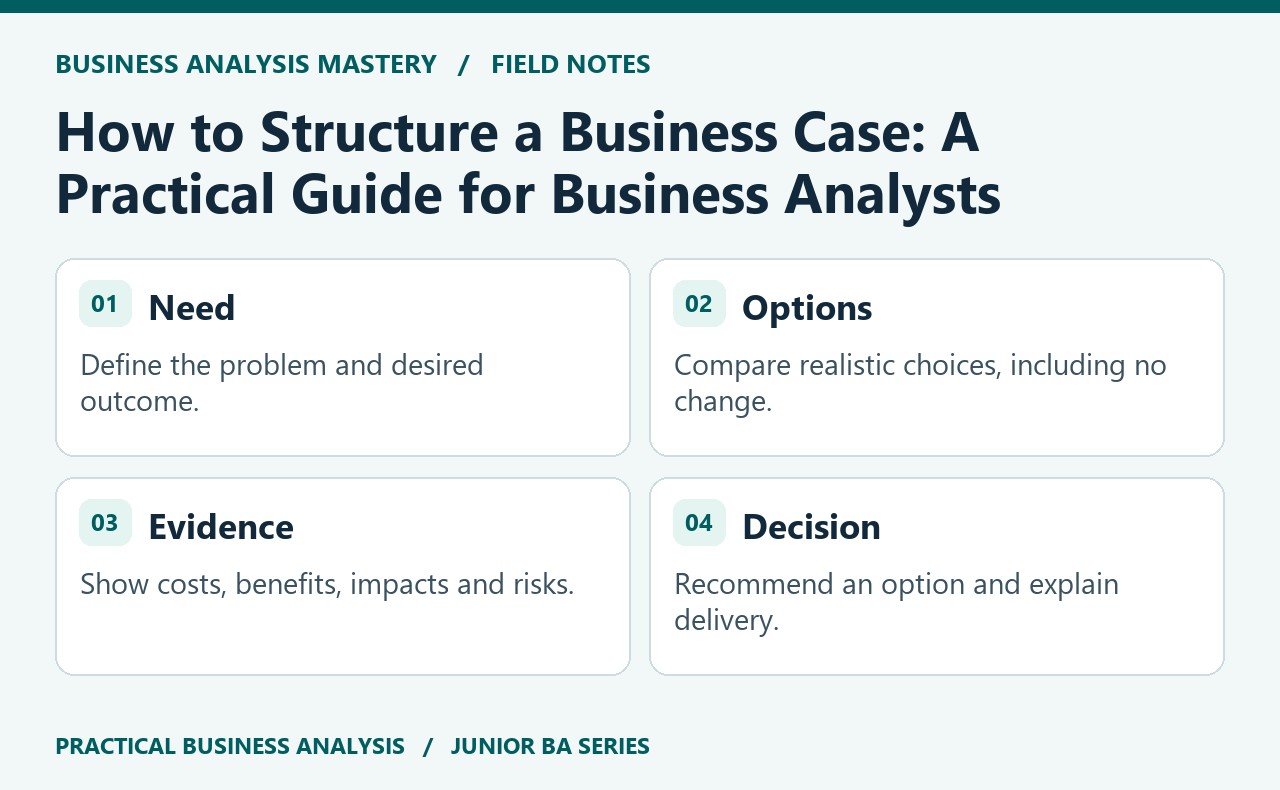
A business case helps decision-makers choose what to do and why. Use this structure to connect the problem, evidence, options and recommendation.
Start with the decision
A business case is a decision document. It explains a problem or opportunity, the choices available and the evidence behind a recommended way forward. It is not simply a request for funding, and it should not assume that approval is already settled.
Before drafting, ask the sponsor what decision is needed, who will make it and by when. Check whether your organisation has a required template, approval route or appraisal method. These vary, so use local guidance where it exists.
Build a clear line of reasoning
Describe the current situation and the outcome the organisation needs. Use evidence where possible: service data, user feedback, audit findings or agreed strategy. Separate facts from assumptions, and say where evidence is incomplete.
Set out credible options, including keeping things as they are. Explain how each option meets the need, then compare costs, benefits, risks, dependencies and impacts. A short list of criteria can make the comparison easier to follow. Include a proportionate financial appraisal with Finance colleagues; do not make financial assumptions alone.
Make the recommendation explicit. Explain why it is preferred, what resources or approvals it needs, how delivery could be staged and how success will be measured. Put detailed calculations, research and models in supporting appendices so readers can check them without losing the main argument.
Worked example: a slow approval process
Suppose staff report that customer applications take too long to approve. First establish the baseline: current average processing time, volumes, rework and service impact. Confirm the target with the service owner rather than inventing one.
Then compare options such as retaining the current process, clarifying guidance and training, or introducing a workflow tool. Estimate implementation and ongoing costs with the relevant specialists. Consider data protection, staff capacity, accessibility and what happens if demand changes. Recommend the option that best meets the agreed need, with measurable indicators such as processing time and error rate.
Review before you submit
Check that the problem, evidence, options and recommendation tell one consistent story. Test whether a reader can see the assumptions, risks, ownership and next decision. Ask a colleague who was not involved in the analysis to review the draft for clarity.
A strong business case is concise in its main narrative and transparent about uncertainty. For more practice with options, evidence and recommendations, explore BA Mastery’s business analysis learning resources.