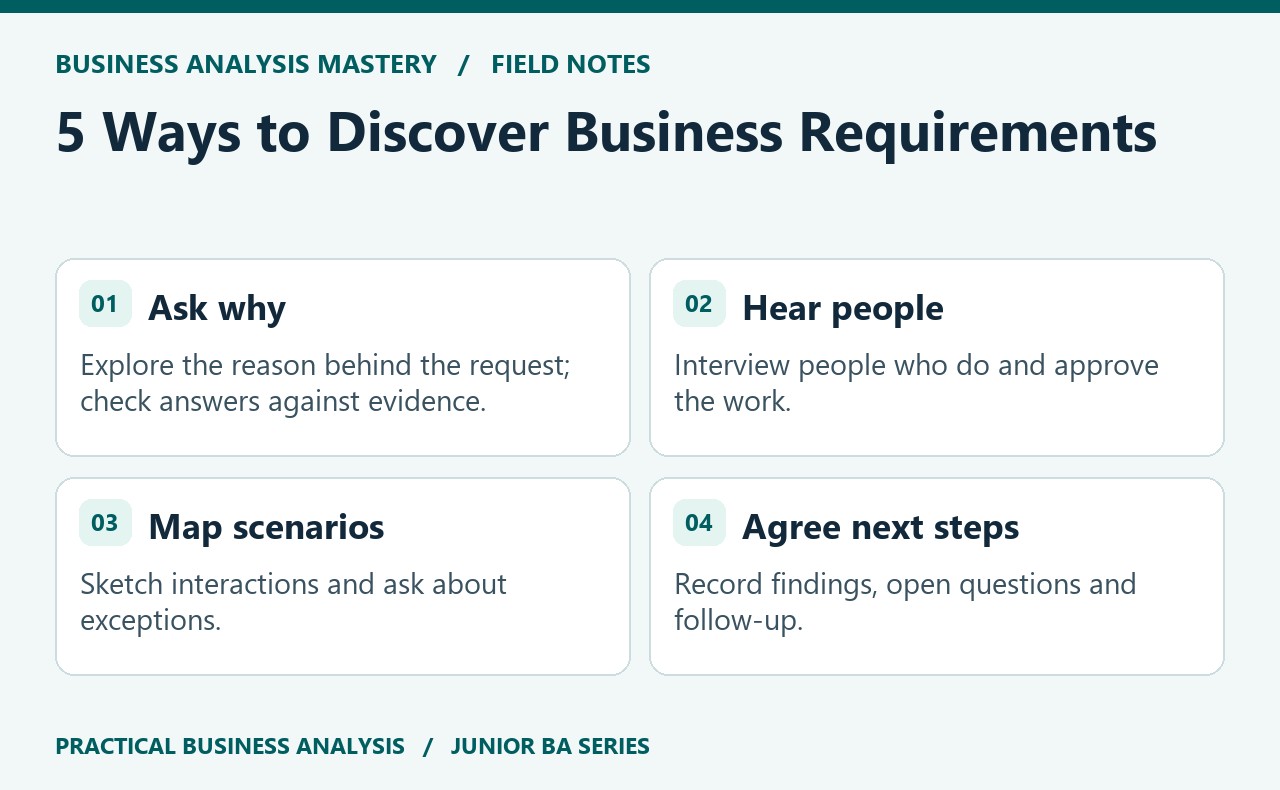
5 Ways to Discover Business Requirements
Requirement discovery helps you understand the outcome people need before the team settles on a solution. These five techniques give you different ways to explore the problem, hear perspectives and identify what still needs checking.
Start with the outcome
A stakeholder may ask for a new approval screen, but that request is already describing a possible solution. Before documenting it as a requirement, find out what is happening today and what the business wants to improve. Perhaps expense claims are taking too long to review, or managers cannot see which claims need attention. Those are different problems and may call for different changes.
Discovery is the early work of understanding objectives, people, current ways of working and constraints. It does not finish every requirement. It gives you enough shared context to decide what to explore next, which assumptions need evidence and who should be involved. Keep a simple record of findings, open questions and decisions as you go.
Five useful discovery techniques
-
Ask why, then check the evidence. Follow a request with questions such as “What happens when this is delayed?” and “Who is affected?” A chain of why questions can uncover a root cause, but do not assume that five questions always reveal the answer. Compare what you hear with examples, data or observation.
-
Interview people who experience the work. Prepare open questions, then let the conversation develop. Ask an employee how they submit a claim and ask an approver what information they need. Different roles may describe the same process differently; record those differences as points to validate, not as errors.
-
Sketch a use case or interaction. A simple diagram can show who uses a system and what they need to do with it. For expense approvals, the actors might be an employee and a manager. Keep the boundary clear: the sketch helps discuss scope; it does not prove which features should be built.
-
Explore scenarios and exceptions. Ask “What if the receipt is missing?” or “What if the manager is away?” These questions reveal alternate paths, rules and unanswered decisions that a happy-path description can hide.
-
Brainstorm with a purpose. Invite relevant people to suggest causes, needs or options against a clear question. Group similar ideas, note disagreements and distinguish evidence from suggestions. Brainstorming generates possibilities; it does not mean every idea becomes a requirement.
Turn discovery into next steps
Imagine the team hears that “claims need automatic approval”. Ask what should be automatic, under which conditions and who remains accountable. An employee might say small claims should move quickly; finance may need a receipt; managers may need to review higher amounts. Capture these as separate perspectives, then check the policy and sample claims before writing a specific rule.
After a session, summarise the outcome in plain language: the business objective, what you learned, assumptions to verify, open questions and suggested follow-up. For example, confirm the approval threshold with finance and observe how rejected claims are handled. Then decide whether another interview, process walkthrough or focused workshop will close the gaps.
Choose the next technique deliberately
No single technique uncovers everything. Interviews help you hear individual experience; scenarios surface exceptions; diagrams make relationships easier to discuss. Match the method to the question, involve the people closest to the work and revisit your understanding when new evidence appears. Once the need is clearer, you can develop and validate requirements that are specific enough for the team to assess.
If you are practising this on a live assignment, take one current request and write down its intended outcome, one assumption and one question to validate. The Requirements Writing course explains how to carry that analysis into clear, testable requirements.
