How to Identify Project Stakeholders: A BA’s Practical Checklist
A stakeholder list is a useful start, but it rarely tells the whole story. Use these checks to find the people who shape, deliver or experience a project’s outcomes.
Start with the people and records already close to the work
A stakeholder is a person, group or organisation that affects or is affected by a project. Alongside the sponsor, project manager, delivery team and users, consider support teams, suppliers and groups whose work may change.
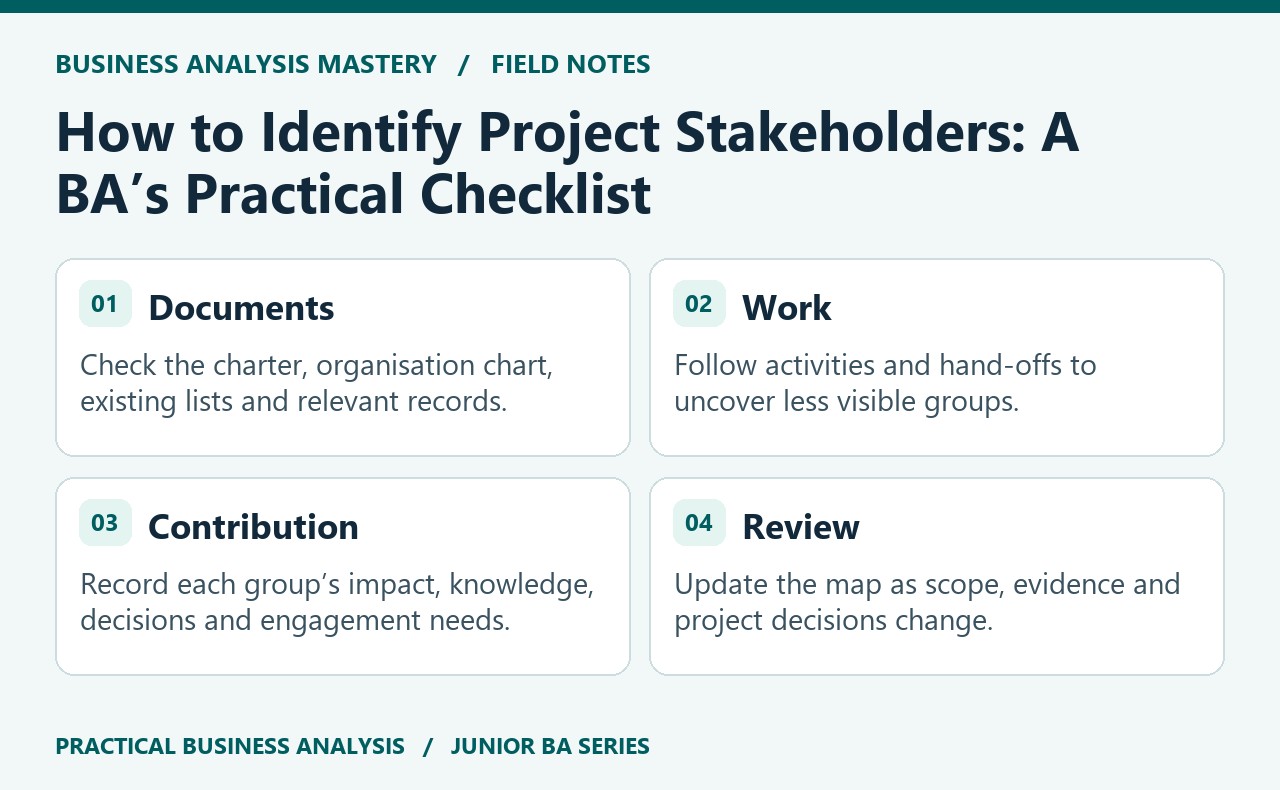
Ask for the project charter, organisation chart and existing stakeholder list. Check roles, affected departments, decision routes, dependencies, dates and document owners. Treat these records as clues, not proof that the list is complete.
Speak with people who know the current work. Ask who performs each step, receives the output, handles failures or gets contacted when something goes wrong. Follow hand-offs across team boundaries.
Use questions that reveal impact and influence
Ask who will use the result, owns a rule, approves decisions, provides a dependency or must change daily work. Consider who might be excluded if design reflects only the most visible users.
Influence is not the same as importance. A senior decision-maker may approve funding; a frontline colleague may know the exception that determines whether the process works. Record what is known and what needs confirmation.
A simple record can capture each person or group, their role, affected activity, knowledge or decisions, contact route and next engagement. Keep personal information relevant and follow organisational policy.
Turn the map into an engagement plan
Use the map to choose how to involve people: observe a task, interview a specialist, ask a team to review a process or bring groups together to resolve a shared rule.
For an address-update change, service staff explain current checks, data colleagues describe validation rules and support staff report common errors. A workshop compares the views; a policy owner confirms mandatory rules. Give each activity a clear purpose and output.
If responsibilities are unclear, discuss them with the project manager. A RACI matrix can help, but it does not replace conversation or grant authority.
Review the list as the project changes
New stakeholders may emerge as analysis reveals systems, teams, impacts or dependencies. Revisit the map after discovery, scope decisions and solution changes. Check for missing groups and untested assumptions.
Record additions and follow-up. If someone cannot attend, agree how their evidence will be represented and how they can review the outcome. Explore concerns before deciding what to do; disagreement may reveal a risk or missing requirement.
Stakeholder identification is ongoing. A current map helps a junior BA hear relevant perspectives and gives decisions a stronger evidence base.