Plan and Facilitate a Requirements Workshop: A Practical BA Guide
A well-run workshop helps a team resolve questions together. Use this practical sequence to make the time useful before, during and after the session.
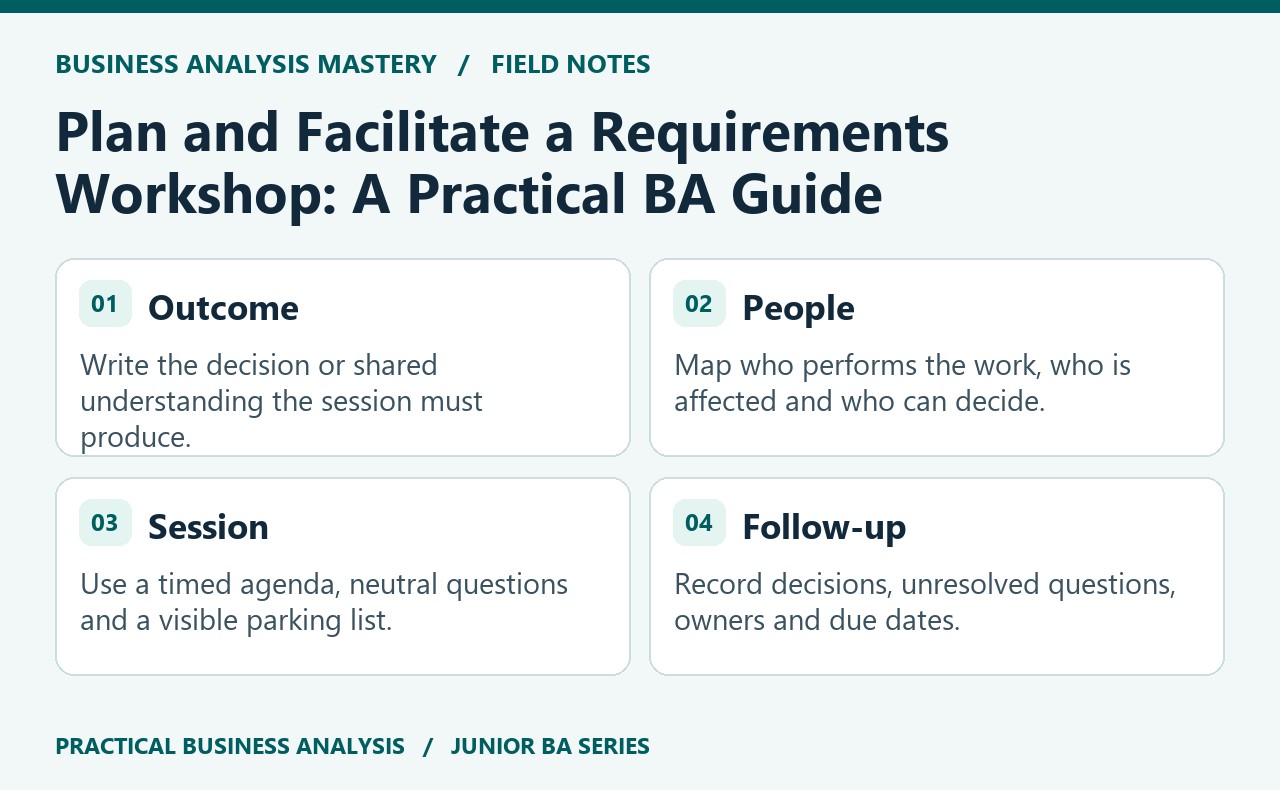
Start with a decision or outcome
A workshop helps several people clarify a topic, compare views or agree what happens next. It is not always the best way to gather requirements: use an interview for a private account or a short written check for a straightforward question.
Before booking time, write one sentence describing the result you need. For example: “By the end of this session, the service team and operations team will agree which customer details are required when an address change is submitted.” This gives you a test for every agenda item. If an activity does not help reach the result, remove it or plan it for another session.
Turn the outcome into a few questions: What happens today? Where do hand-offs fail? Which rules are fixed? Share them in advance so attendees can bring relevant examples or documents.
Invite the people who can explain or decide
Ask who is affected, performs the work, owns the rules and can make a decision. A team list is a starting point: frontline staff, service users, suppliers or support teams may know parts missing from project documents.
Keep the group small enough for everyone to contribute. Explain why each person is invited and what you need. If a decision-maker cannot attend, agree how to record options and get a decision later.
Use a timed agenda and facilitate neutrally
Send an agenda with the objective, preparation and timings. A 90-minute session could cover the goal, current process, exceptions, requirements, open questions and actions. Leave a little buffer.
Explain how you will capture decisions, assumptions and open issues. Ask “What happens next?” or “Can you give us a recent example?” Invite different views and ask what evidence or rule could resolve disagreement.
When discussion drifts, summarise it on a visible parking list and agree an owner. Pause to read back notes so participants can correct them.
Close the loop after the meeting
Before people leave, recap decisions, questions, actions, owners and dates. Turn “we will look into it” into a specific task, such as confirming whether a validation rule applies to overseas postcodes by Friday.
Send notes within two working days. Ask attendees to correct misunderstandings, then update the requirements, process model or decision log and link changes to their source.
Success means the outcome is clearer and remaining work has a route forward, even if not every issue was settled.